Goldstein Group Communications

Mastering the Complex Sale: A Digital Marketing Playbook for B2B Manufacturers

In olden times (perhaps just 15 years ago!), the B2B sales and marketing ecosystem seemed simple.

  • We all lived inside a logical, linear sales funnel. Leads went in at the top and moved logically, linearly and smoothly down the funnel.
  • Buyers were easy to find – and easy to reach. We knew the individual who made the buying decision. And he or she worked in an office with a phone they even answered.
  • Buyers made decisions quickly, with sales cycles measured in a few weeks.

Oh, the nostalgia of a simpler time! Today’s B2B buying market is characterized by long sales cycles, with decisions made by teams of ever-changing people, and a circuitous stop-and-start sales process that is anything but predictable and linear.

Many sales deals involve complex technologies or innovations that are anything but straightforward. Information is available from so many new sources today, and people have embraced the idea of doing their own research before engaging with a company’s salespeople.

Digital marketing technologies have improved as well, with software that’s better able to target a specific buyer at the moment they’re looking to buy with messaging tailored to that person’s industry, job function, location or whatever is most persuasive and relevant.

The simple sales funnel? This outdated “fallacy of the funnel” has been replaced by what’s the consulting firm Gartner Group coined as “the complex sale.” This paper will discuss how B2B sales and marketing leaders can plan for it – and conquer it.

A New Buyers Journey

complex saleFor manufacturers and service providers, the complex sales challenges are magnified by extensive technical evaluations, a thirst for detailed online information and product comparisons, and multi-channel distribution approaches that companies use that blend direct sales teams, third-party sales representatives and distributors, sometimes all at once. These transactions are rarely smooth and predictable and often demand rigorous contact and coordination across departments.

Buyers have only become more comfortable doing their own research before making contact with a salesperson, with most studies showing that 6-75% of the buying process has already been concluded when a salesperson actually hears from a prospect. Buyers today prefer to self-educate, access peer reviews, and compare options long before any human interaction. Digital channels now serve as the primary entry point to your brand, value proposition and competitive advantages.

Coordinated strategies between digital marketing teams and sales personnel are needed to bring order to this chaos. A defined, documented process can shorten sales cycles, help buyers cut through complexity, and elevate brand preference over mere awareness.

At Goldstein Group Communications, we specialize in making sense of the complex sales journey, making it simpler, faster and more predictable. By using a blend of more advanced AI-based technology tools, we can often leapfrog to the middle-of-the-funnel, where buyers already exist who are searching for your product, rather than focus on early-stage researchers at the top of the funnel, at the beginning of the process.

Conquering the New Complex Sales Cycle

B2B sales have never been easy. The initial revenue or the potential for ongoing revenue from an OEM, for example, is large, so in many cases the stakes are high. A marketing and sales team by definition then must find ways to navigate and stay connected to various teams of decision-makers as they travel through all four distinct phases of the complex sales cycle:

  1. Problem Identification
  2. Solution Exploration
  3. Requirements Building
  4. Suppler Selection

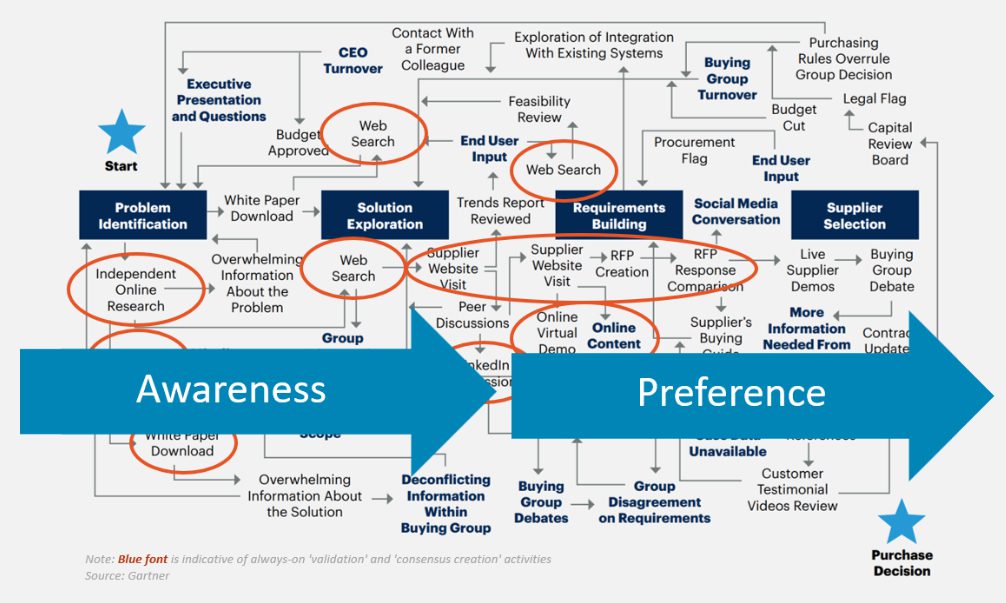
Figure 1. The complex sale process

You can see Gartner’s visual in Figure 1. It’s almost incomprehensible with its numerous cyclical and overlapping paths.

You can see the many and even repetitive communication points circled in red on Figure 1 where companies must find ways to insert themselves into the Complex Sales Journey. Web searches appear throughout the journey. Testimonials and peer reviews pop up frequently. White papers and even social media enter the picture at critical junctures.

You can even consider this a simplified version, because it doesn’t begin to address the additional layers added by various sales channels – are you talking to a direct salesperson, a third-party rep or outside distributor? Materials and processes change at each of those various channel points. Sales representatives know their territories but are not experts on your company’s products. They also share their time with your products and those of other companies that they represent, so how does your company ensure they’ll pay enough attention to you? Distributors and resellers provide availability, geographic coverage, a ready customer base and convenience, but they can often struggle moving prospects on their own from early stage awareness to preference on a technical sale without assistance from the “factory.” Each channel must be equipped with appropriate messaging and information to support its function in the sales process.

Are You on a Mission to Finally Discover You Marketing ROI?Click to Learn More

Addressing the Challenges That Complicate the Complex Sale

Certainly, all this can become a minefield for many companies, with a variety of areas that need to be tightened up to successfully navigate in the Complex Sale environment:

Balanced content throughout the complex sale journey

Marketing teams often produce white papers and early-stage content tools that are ideal for building awareness at the early stage of a decision. However, many tend to leave a gap in the middle stages of the process that must convert awareness into preference for your solution. Testimonials, calculators, comparison materials, tear-down videos and other types of tools must be visible and present in the critical middle stages of the complex journey to push buying teams to select your product or service.

Crisp differentiation

The need for COMPARATIVE messaging in all materials and sales presentations is paramount, particularly because prospects are doing evaluations and making judgments on their own. Value props and product advantages have to be easy to find, front and center. “Don’t tell me what you do; tell me what you do BETTER has to become the mantra for every touch point you have with a prospect. Your sales force needs reasons to justify why your prospect should purchase your product or service. They need to know what your product or service does better for their needs. With a lack of differentiation, the only lever your sales team has is price, a losing proposition.

The role of new technology solutions

In mastering the complex sale, generating high-quality leads that turn into meetings requires more than just casting a wide net - it demands precision targeting and intelligent qualification. Goldstein Communications Group helps B2B companies deploy modern marketing tools to identify, score and engage the right prospects. Tools like ZoomInfo provide deep intelligence on company attributes, decision-makers, and industry segments, enabling precision targeting and account-based marketing (ABM). ZoomInfo offers rich company and contact data, including direct emails and phone numbers, so sales teams can focus on prospects that fit the ideal customer profile. “De-anonymizer tools like TAM Surfer, Datashopper or RB2B go a step further by identifying anonymous visitors browsing specific, high-intent pages on your website - signaling genuine interest and readiness for engagement. These insights allow marketing and sales teams to prioritize outreach to prospects already signaling buying intent. This data-driven approach ensures that marketing efforts are concentrated on buyers who are not only a good fit but are actively in-market, improving conversion rates and pipeline quality.

To turn these qualified prospects into meetings, companies should begin to layer LinkedIn ads, retargeting campaigns, and AI-driven personalized emails from inside sales personnel, creating multiple touchpoints that reinforce your value proposition. Effective campaigns give prospects a compelling reason to engage – whether that’s a product demonstration, a free audit, a consultation with an expert, or a benchmark report that helps them assess their current position. These offer-based campaigns not only generate interest but also provide clear value.

Layering on behavior-based nurturing sequences creates a responsive, personalized experience. For example, if a prospect visits a product page, watches a video, or downloads a white paper, they can automatically enter a tailored email sequence that reflects their interest.

Platforms like HubSpot and Salesforce, when integrated, allow marketing and sales teams to coordinate seamlessly and automate this buyer-centric approach at scale. To make the path to a meeting seamless, integrate automated scheduling tools into your outreach so prospects can book time with a salesperson or engineer in just a few clicks. Strong calls to action—such as “Talk to an engineer about your project” or “Get a free performance benchmark”—can significantly increase response rates. By combining precise targeting, valuable offers, and frictionless scheduling, Goldstein Communications Group enables B2B companies to build meeting flows that drive meaningful sales conversations and pipeline growth.


Tight cooperation between marketing and sales

Do sales and marketing teams agree on the definition of what makes a good lead? Absence of teamwork results in misalignment on goals, essential information, the ideal customer profile, and follow-up accountability.

Hunters vs farmers on the team

Growth can never be achieved if companies have more farmers on their sales teams than hunters. Hunters drive for new prospects and uncover new opportunities. Farmers are wired to serve existing accounts.

Channel conflict

Sales management must ensure each sales channel understands its role and facilitates multiple appropriate points of contact but avoid duplicative contact. When is a third-party rep most productive, and how do you train and hold them accountable for goals? How can you build mind-share in distribution channels? Multiple sales channels can be a driver for growth in the complex sale environment, but only with the proper sales structures in place.

Documented sales process

It’s amazing how often companies have detailed documentation on every department in their companies – except sales. This is particularly critical to successfully navigate the complex sale environment. While no step-by-step set of instructions can completely address the variability of a complex sale, a set of guidelines and procedures can ensure that:

  • Action is taken on all opportunities – No opportunities get lost due to confusion over responsibilities for territories or account categorization.
  • Funnel management is facilitated - Sales personnel keep opportunities, opportunity status information, and meeting notes updated in the CRM
  • Appropriate documentation is made available - The prospect is exposed to messaging that addresses their problem.
  • Meetings with defined purposes are scheduled – Meetings can answer questions, provide demonstrations, plan for an evaluation, or provide specific information to different members of the purchasing team.
  • Services that enable the sale are offered – Guidelines based on the product or service under consideration determine whether sales personnel can provide demonstrations, evaluations, engineering consultations, and custom evaluation software.
  • Nurturing prospects during a long sales cycle – Salespeople must ensure the prospect continues to consider the company’s product or service, keep the prospect updated on product/service enhancements, keep current on requirement changes, and be cognizant of changing personnel and dynamics in the purchasing team.

Sales Tools That Sell

A datasheet, by itself, is not adequate information to support the sales force. The old line, “all I need is a data sheet and feet on the street” is a brute force sales philosophy that is both outmoded and ineffective.A well-designed sales guide is an essential tool for mastering the complex sale, enabling B2B sales teams to engage the right prospects, uncover their challenges, and present compelling solutions that drive action. It must answer these questions:

  • Sweet Spot: When I see a customer that looks like this or is doing that, I know they’re a great fit
  • Sweet Spot Title: The people who are MOST likely to buy, and have the authority to buy, have these titles
  • When a customer complains about these things, I know they’re a great prospect
  • These are the things my product does better than anyone else
  • This is what I have to say to get someone to switch from another product to mine
  • This is what I say when they ask me for proof that my product can really do what I claim
  • These are the sales barriers and objectives I have to overcome, and what I say to overcome them
  • This is my prospecting call script, email copy and LinkedIn message
  • These are the sales tool resources that are available to use

Better results begin with a better message

Marketing needs to support their direct sales force and the multiple sales channels with tools that enable moving complex sales to a successful conclusion. To accomplish this, marketing must understand and build a comparative-driven message architecture for the product or service. We call this the differentiation triangle (Figure 2) that presents:

Trigger messages

Understanding and detailing the problems that were so painful, so compelling, that it drove the prospect at that moment to search for a new solution. Understanding this provides a window into what content will motivate a buyer and push them to you more than your competitors.

The “onlys”

Every product or company has advantages or attributes that ONLY are provided by you. Those need to be crisp and forward, showcasing what you do better than anyone else in the world. We’re of course borrowing here from Jim Collins’ famous book “From Good To Great,” where he says that identifying what you’re “best int eh world” at offering is what’s needed to create clear, compelling messaging.

Switch messages

The most difficult element of crisp messaging is to define what it takes to get people to switch from an existing company to yours. This must be a high enough bar to justify the hassle, cost and complexity of changing vendors, which for many companies and products can be significant.

For example, a measurement instrument company developed a product for testing a high-volume consumer electronics product that increased throughput by an impressive 25%. The company believed it had a winning solution for manufacturers. The product failed because the switching cost for the manufacturers was so high that it required savings greater than 25%; even the millions of dollars saved wasn’t enough to carry the day. Neither marketing nor sales had gathered the knowledge to understand the magnitude of the switching costs.

Your Playbook for Mastering the Complex Sale

You may never be able to memorize all the possible pathways of the complex sales cycle, but you can improve your success rate and grow your sales with a positive ROI from your marketing budget. The complex sales cycle is a dynamic, evolving process. You must now facilitate the entire journey: from attention → to conversation → to close:

  • Align with sales management on project goals, ideal customer profiles and documented sales methodologies
  • Create effective trigger, only and switch messaging (the differentiation triangle)
  • Create middle-stage content using vehicles such as application notes, success stories, handbooks, videos, webinars, product comparisons, and ROI calculators
  • Build a content-rich website with an effective search tool and a chatbot
  • Use SEO to drive multiple members of a purchasing committee to your website
  • Use database tools to identify prospects who are searching for a solution to the problems your product or service solves
  • Execute targeted, compelling outbound and nurturing campaigns
  • Support the sales force with a sales guide and sales enablement tool
  • Use analytics to refine messaging and tactics over specific timeframes.

Complexity doesn’t have to apply to your sales and marketing strategies. By understanding and accounting for the transition from simple sales funnels to the new journey map outlined by Gartner Group, you’ll be able to cut the cost of sales and marketing by building a system that finds buyers for less money who close faster and spend more.

complex sales playbook
×