

No Kidding, B2B Digital Marketing Has Changed. Here’s What To Do Next to Protect Your Pipeline
Are we tired yet of talking about the structural shift taking place in B2B digital marketing? If it’s not AI, it’s how hard it is to reach prospects. If it’s not complex and long sales cycles, it’s the greater need to document real sales generated by marketing.
It’s like the weather – everyone complains about it. But it’s real, and it requires an immediate re-think into how you build your B2B marketing campaigns. Let’s dig into the 5 structural shifts taking place and then transition to the key “pivots” to make in your B2B marketing plan.
- The Old Top-of-Funnel Model Is Losing Efficiency For years, B2B marketing teams could justify performance with white paper downloads, gated eBooks and “Marketing-Qualified-Lead” (MQL) volume. But that model is producing too many contacts who are researching, lack authority, don’t have budget, or are simply too early in their buying process to create revenue anytime soon.
Today, it’s more about the Middle of the Funnel. B2B marketers are using new technology tools to move beyond reporting on Leads, MQLs and Sales-Qualified-Leads toward harder business outcomes like sales meetings, quoted opportunities and pipeline contribution. That is not just a reporting adjustment. It is a more accurate definition of what marketing is supposed to produce.
It comes down to Outcomes, not Activities: if sales is starving for real opportunities among ready buyers, marketing cannot keep optimizing around these lesser activity metrics alone.
- The Complex Sale Has Broken the Linear Funnel Journey The traditional sales funnel assumes buyers move neatly in a linear fashion from top to bottom, uninterrupted, from awareness to consideration to decision. That is not how most B2B buying works today, especially in industrial, manufacturing and technical sectors. The linear sales funnel has been replaced by the complex sale journey mapped best a few years ago by Gartner Group.
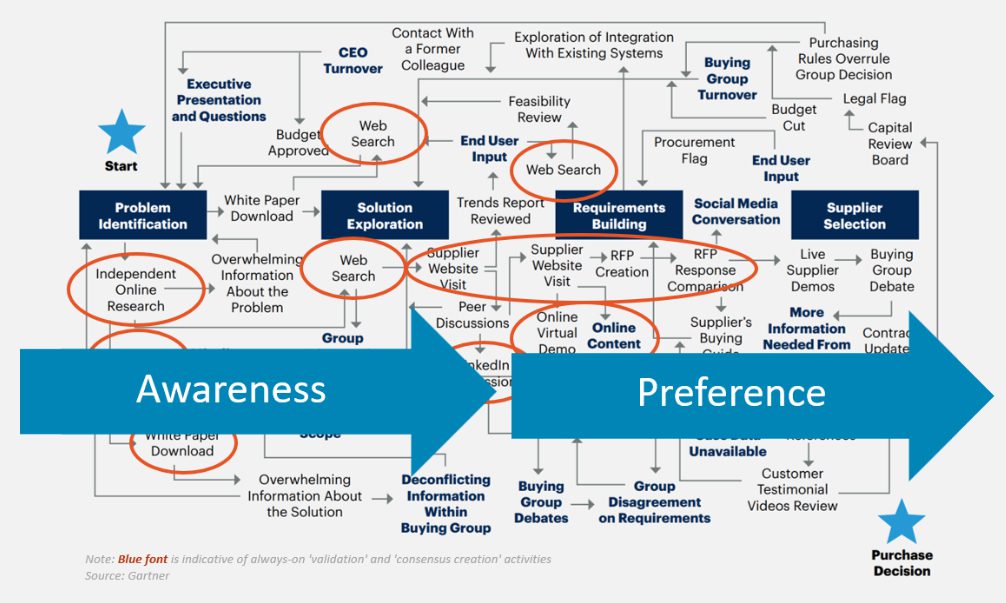
Complex sale journeys involve multiple stakeholders, competing priorities, stops-and-starts and repeated loops from assessment to selection. One person may care about product performance. Another may focus on implementation risk. Another may need ROI justification. Some may look for solutions on social, and others may walk the floor of a trade show. Marketing has to support all of that.
This is why underinvesting in the middle of the funnel activities, as mentioned earlier, is such a costly mistake.
In complex sales, the middle is often where deals are won or lost. Buyers need help making sense of tradeoffs, building internal consensus and reducing perceived risk. That requires stronger mid-funnel content and enablement assets, not just more awareness, thought leadership and white paper content.
- Middle-of-Funnel Tools Like ZoomInfo and De-anonymizers Matter More Than Ever Tools like ZoomInfo and De-anonymizers are important, but not because they provide bigger contact databases. Their real value is in helping marketers and sales teams find people who are in the buying process NOW, not early stage leads and researchers with no budget.
When used strategically, ZoomInfo can help teams identify active accounts, understand relevant search intent, enrich CRM records and coordinate outreach around real engagement. That makes it possible to shift budget away from broad lead capture and toward mid-funnel opportunity creation.
De-anonymizers are a relatively new type of tool that identifies the NAME/EMAIL/PHONE number of the person who visited your site – but left without filling out a form. They’re far more effective than lead tools that just tell you the domain of the visitor. That’s essentially of no value to a salesperson. Instead, the de-anonymizer tool identifies their specific work contact information, how they got to your site, and what pages they visited. A gold mine for sales!
That is a much smarter use of spend in markets with long sales cycles and expensive sales resources.
Remember, the software itself is not the strategy. Too many companies buy these platforms without designing the staff support, workflows, responsibilities and follow-up actions required to turn signals into pipeline. The ROI comes from orchestration, not just identifying the name.

ebook
Discover Your Marketing ROI
Learn how we drive leads that convert into customers, and how to measure the ROI they generate
View eBook - Engineering Buyers Expect Better Content, More Than Brand Messages If you’re selling to engineers or a technical buyer, this shift is even more pronounced. Engineers are highly self-directed. They want to research independently, compare options on their own and engage with vendors only after they have made meaningful progress.
That changes the job of marketing.
It is no longer enough to publish polished brand copy and a few thought leadership assets. Marketers now need to build a digital buying environment that helps technical audiences evaluate solutions without needing sales to explain the basics.
That means your website and content must do more of the heavy lifting. In many cases, buyers need access to:
- Detailed product and application information
- Technical FAQs and specifications
- Live chat and self-service FAQ tools
- Demo videos, tear-down videos, animations and proof-oriented case studies
- Comparison content and implementation guidance
- ROI calculators and business-case tools
- Objection-handling and technical validation assets
- Testimonials, use cases and sales enablement materials
If your messaging stays high-level while your audience is looking for concrete evidence and technical relevance, your funnel breaks down long before a lead form is submitted.
- AI Is Raising the Standard, Not Lowering It What do you do if people stop coming to your website? It’s an answer you’d better have on hand, because it’s happening today.
AI is re-defining marketing in two ways – AI search is interrupting and diverting traffic from ever getting to your site. However, on the plus side, it’s presenting a series of tools that can greatly help to accelerate sales. Let’s touch on both.
For search, AI is presenting answers to complex questions before your prospect ever scrolls down to find that coveted #1 organic position you worked so hard to achieve on Google. For many, ChatGPT, Gemini, Claude, etc. have replaced Google completely, so the path potential buyers used to take to find you – search query, your search listing, then click – has been forever broken. Many companies are reporting traffic declines to their site of 20-30%, and there’s a sense that we’re still searching for the bottom of that decline. The conversion from competing for organic rankings in an SEO mode to AEO/GEO (AI Engine Optimization/Generative Engine Optimization) is in full swing, in order to get included in those AI searches on Google and other platforms.
The second AI component to consider is how new AI tools can be used to accelerate sales. Intent targeting, campaign generation, ad creation, message testing, workflow automation – it’s all exploding with AI improvement tools in ways that let marketers shift human effort toward higher-value work. Our work doesn’t just become faster – AI tools are helping us build better programs with more ready access to best practices and more thoughtful strategy.
The companies that benefit most from AI will be the ones that use it to improve decision quality, not just increase output.

What Marketers Should Do Next
With all this in mind, here are four “pivots” you should consider for your B2B marketing program. These are not an attempt to chase every new tool or trend. It is to adjust your operating model so marketing is better matched to how technical buyers actually buy today.
- Measure opportunity quality, not lead quantity. Build reporting around sales-accepted opportunities, meetings created, quoted opportunities, influenced pipeline and conversion by stage. If your dashboard still centers on MQL or even SQL volume, you are probably optimizing for the wrong outcome.
- Rebuild content around the real decision journey. Audit your content by sales stage, buyer role and buying question. Most teams have enough top-of-funnel awareness content but not nearly enough middle-of-funnel content types mentioned above. Focus on the messy middle, where buyers need proof, clarity and internal justification.
- Operationalize intent data. Connect ZoomInfo, de-anonymizer and related tools to HubSpot or your CRM so account activity triggers action, and then aggressively train your sales teams on how to leverage it. Anonymous website visits, pricing page views and keyword surges should launch specific sales and marketing responses, not just appear in reports.
- Use AI to accelerate campaigns, improve strategy execution, and uncover more ROI indicators. Apply AI to analysis, testing, workflow design and optimization, while keeping humans responsible for positioning and judgment. In technical B2B markets, credibility and accuracy are too important to automate blindly.
The New ROI Standard in B2B Marketing
The result is clear: lead gen has given way to sales opportunity generation; top-of-funnel programs take too long and cost too much to rely upon; and it’s time to expect that AI functions as more than just another search engine or blog writer, in order to accelerate sales.
The marketers who improve ROI over the next few years will not be the ones who generate the most leads. They will be the ones who draw a straight line from lead-to-quote-sale and use new tools to make that line shorter than a competitor’s.
For teams willing to adapt, it creates a better model—one that is more measurable, more sales-aligned and far more likely to produce real revenue impact.